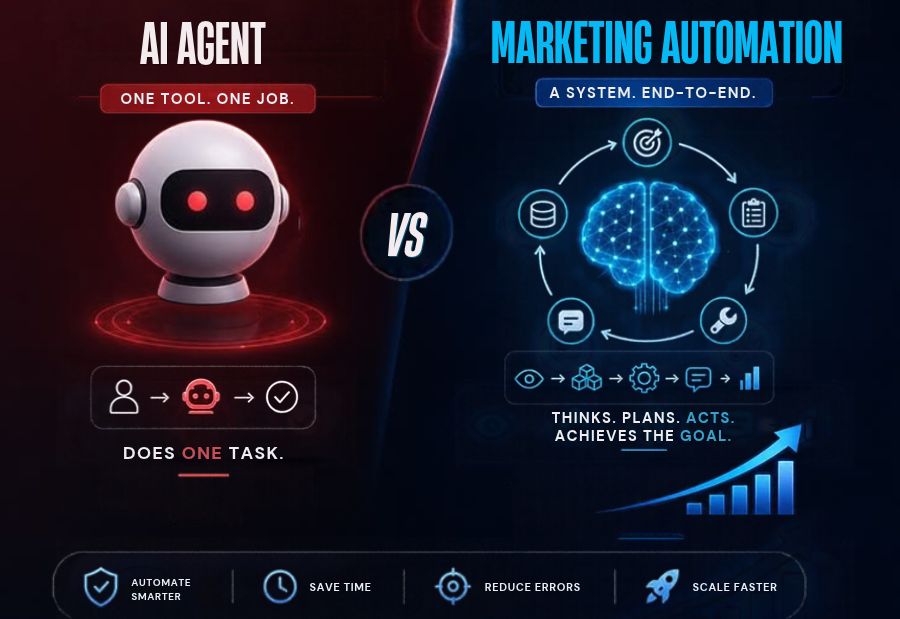
AI Agents vs. Marketing Automation: Understanding Their Roles in Campaign Management
Marketing teams use automation to manage repetitive activities, improve campaign efficiency and maintain consistent communication with prospects. However, the introduction of AI agents is expanding what marketing technology can accomplish. While traditional marketing automation follows predefined rules and workflows, AI agents can analyse information, make decisions within defined boundaries and perform multi-step tasks. Platforms such as HubSpot and Zapier demonstrate how automation and AI capabilities are becoming part of modern marketing operations.
Understanding AI agents vs. marketing automation can help businesses identify which approach is suitable for their campaign management requirements and where both can work together.
What is Marketing Automation?
Marketing automation uses software to execute repetitive marketing tasks based on predefined rules, triggers and conditions.
For example, when someone downloads an ebook from a website, an automated workflow can send a confirmation email, add the contact to a specific list and schedule a follow-up message.
Common marketing automation activities include:
- Sending scheduled email campaigns
- Managing lead nurturing sequences
- Assigning leads based on predefined criteria
- Updating CRM records
- Scheduling campaign notifications
- Tracking user interactions
- Triggering follow-up messages
Traditional automation is useful when businesses need predictable processes that follow consistent instructions. Once configured, workflows can execute tasks with limited manual involvement.
What are AI Agents in Marketing?
AI agents are software systems that can interpret a goal, analyse available information, select actions and complete tasks within their assigned permissions and boundaries.
Unlike a conventional workflow that follows a fixed sequence, an AI agent may adapt its approach based on the information it receives.
For example, an AI marketing agent could review campaign performance data, identify a decline in engagement, investigate possible reasons and prepare optimisation recommendations. Depending on its integrations and permissions, it may also carry out approved actions.
Common marketing applications include:
- Analysing campaign performance and identifying patterns
- Researching audience interests and customer questions
- Supporting personalised content recommendations
- Classifying incoming enquiries
- Summarising customer interactions
- Recommending campaign adjustments
- Assisting with lead research and prioritisation
AI agents can support more flexible tasks, but their results depend on data quality, system access, instructions and human oversight.
AI Agents vs. Marketing Automation: Key Differences
1. Workflow Execution
Marketing automation follows predefined workflows. For example, a prospect who clicks a particular email link may automatically receive a follow-up message.
AI agents can work towards a defined goal and determine the steps needed to complete it. They may analyse context and adjust their actions rather than relying entirely on a fixed sequence.
2. Decision-Making
Traditional automation generally uses rules and conditions configured by marketers. It performs actions when specific triggers or criteria are met.
AI agents can use AI models and available data to evaluate situations and recommend or select actions. However, decisions involving budgets, customer commitments or sensitive information should have appropriate approval controls.
3. Personalisation
Marketing automation can personalise communication using predefined segments, contact attributes and behavioural triggers.
AI agents can use broader context to support more adaptive personalisation. For example, they may help tailor content recommendations based on a prospect’s industry, previous interactions and stated requirements.
4. Adaptability
Traditional workflows usually need manual updates when business rules or campaign requirements change.
AI agents can respond to changing information within their assigned scope. However, they still need clear objectives, reliable data and regular evaluation to avoid unsuitable decisions.
5. Human Involvement
Marketing automation reduces manual effort by executing repetitive activities.
AI agents can reduce the effort involved in research, analysis and multi-step tasks. Human review remains important for strategy, campaign approvals, brand communication and high-impact decisions.
AI Agents vs. Marketing Automation: Comparison Table
| Comparison area | Marketing automation | AI agents |
| Primary approach | Rule-based workflows | Goal-oriented task execution |
| Decision process | Predefined conditions | Context-based evaluation |
| Flexibility | Limited by configured rules | Can adapt within defined boundaries |
| Personalisation | Segments and triggers | Context-aware recommendations |
| Best suited for | Repetitive tasks | Multi-step and information-driven tasks |
| Human oversight | Workflow setup and monitoring | Guidance, review and permission controls |
When Should Businesses Use Marketing Automation?
Marketing automation is suitable for tasks that are repetitive, predictable and governed by clear conditions.
For example, a B2B company can use automation to send a welcome email after form submission, distribute newsletters, assign leads to sales representatives and trigger reminders when prospects engage with specific content.
It is particularly useful when the objective is to standardise campaign execution and reduce manual work.
When Should Businesses Use AI Agents?
AI agents can be useful when marketing tasks require information analysis, contextual understanding or multiple connected actions.
For example, a marketing team could use an AI agent to review customer feedback, identify common concerns, summarise competitor messaging and prepare recommendations for a new campaign.
Businesses should begin with clearly defined, low-risk use cases. Actions such as sending external communications, changing campaign budgets or modifying customer records should require suitable permissions and approval processes.
Can AI Agents and Marketing Automation Work Together?
Yes. Businesses do not necessarily need to choose one over the other. Both technologies can support different stages of a marketing workflow.
Consider a B2B lead nurturing process:
- A visitor submits an enquiry through the website.
- Marketing automation captures the contact and triggers a confirmation email.
- An AI agent reviews the available enquiry details and summarises the prospect’s requirements.
- The CRM workflow assigns the lead based on predefined routing rules.
- An AI agent can help prepare relevant follow-up recommendations for the sales team.
- Marketing automation sends approved follow-up communications according to the configured schedule.
This combination allows automation to handle consistent execution while AI agents support tasks that require analysis and contextual decisions.
Factors to Consider Before Implementing AI Agents
Before introducing AI agents into marketing operations, businesses should evaluate:
- Data quality: Ensure customer and campaign information is accurate and properly maintained.
- Integration capabilities: Check whether the agent can securely access the required CRM, analytics and marketing systems.
- Access permissions: Limit what the agent can view, modify or execute.
- Human approval: Establish review processes for sensitive or external actions.
- Performance measurement: Track time saved, task accuracy, campaign efficiency and business outcomes.
- Data privacy: Ensure customer information is handled according to applicable privacy requirements.
Mercadeo can help businesses connect marketing technology decisions with their wider lead generation and campaign objectives. Selecting tools based on actual business requirements is more effective than adopting AI simply because it is a growing trend.
Final Thought
AI agents and marketing automation serve different but complementary roles in campaign management. Marketing automation is effective for executing predictable, rule-based workflows, while AI agents can support research, analysis and more adaptive multi-step tasks.
Businesses can benefit from combining both approaches based on their campaign needs, data readiness and operational requirements. The goal should be to reduce repetitive work, improve marketing decisions and create more relevant customer experiences without losing human control.
About The Author
