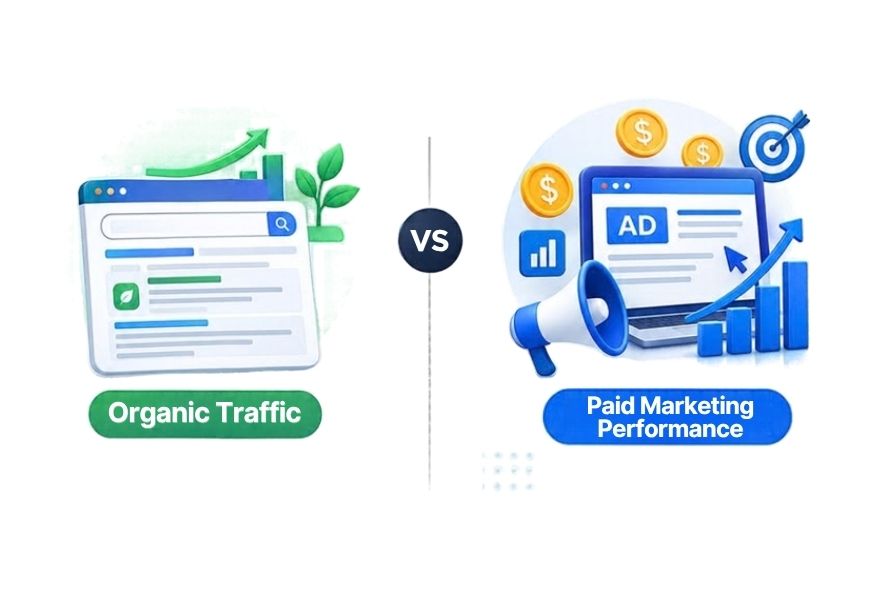
How Can Businesses Compare Organic and Paid Marketing Performance?
Businesses use a mix of marketing channels to attract visitors, generate leads, and build long-term customer relationships. Organic search, content marketing, social media, and paid advertising can all drive growth, but they work differently. Companies like Cognizant and Shopify operate in competitive digital markets where balancing long-term visibility with immediate campaign results matters.
Understanding organic vs. paid marketing can help businesses decide where to invest time and budget. Instead of treating one approach as better than the other, marketing teams should compare their performance based on traffic quality, conversions, costs, and business outcomes.
What is organic marketing performance?
Organic marketing refers to visitors and engagement generated without paying directly for every click or interaction. SEO, content marketing, organic social media, and other non-paid activities can contribute to organic growth.
Businesses can measure organic performance through metrics such as:
- Organic website traffic
- Search impressions
- Keyword rankings
- Organic click-through rate
- Engagement
- Leads generated
- Organic conversions
- Returning visitors
Organic marketing often takes time to build. However, well-optimized content can continue attracting visitors after it is published, making it an important part of long-term digital visibility.
What is paid marketing performance?
Paid marketing involves spending money to reach specific audiences through platforms such as search advertising, social advertising, display campaigns, and sponsored content.
Common paid marketing metrics include:
- Impressions
- Click-through rate
- Cost per click
- Cost per lead
- Conversion rate
- Cost per conversion
- Advertising spend
- Revenue generated
Paid campaigns can provide faster visibility and allow businesses to control audience targeting, budget, messaging, and campaign duration.
How should businesses compare organic and paid traffic?
Traffic volume alone does not provide enough information. A business may receive significant traffic from one channel but generate fewer qualified leads from it.
Businesses should compare organic and paid traffic based on:
Traffic quality: Which channel brings visitors who spend more time exploring relevant pages?
Conversion rate: Which channel produces a higher percentage of desired actions?
Lead quality: Are visitors becoming qualified leads or simply submitting low-value forms?
Customer acquisition: Which channel contributes to more customers?
Looking at these factors provides a better picture of performance than comparing visits alone.
Which channel generates better leads?
The answer depends on the business, audience, and customer journey.
Organic visitors may arrive after searching for a problem, solution, or educational topic. This can make SEO valuable for reaching people during research.
Paid visitors may come from highly targeted campaigns built around specific audiences, offers, or search terms. This can make paid marketing useful when businesses need to reach a particular audience quickly.
Marketing teams should therefore compare the quality and intent of leads generated by both channels.
How should businesses compare marketing costs?
Organic marketing does not mean marketing without cost. Businesses may invest in content creation, SEO tools, technology, employees, agencies, and optimisation.
Paid marketing has more visible costs because businesses directly pay for advertising activity.
A useful comparison should consider the total investment required to generate meaningful outcomes. Metrics such as cost per lead, cost per qualified lead, customer acquisition cost, and revenue generated can provide more useful insight.
Can organic and paid marketing work together?
Yes. Organic and paid marketing can support different stages of the customer journey.
For example, a business can use paid campaigns to promote an important service or offer while using SEO content to attract people researching related topics. Data from paid campaigns can also provide insights into audience interests and messaging that may help improve organic content.
Similarly, strong organic content can be promoted through paid campaigns when businesses want to increase its reach.
This creates a more connected marketing strategy rather than forcing teams to choose between the two channels.
What should businesses measure over time?
Performance should be reviewed across consistent time periods rather than based on individual campaigns or short-term changes.
Businesses can create a simple comparison covering:
| Metric | Organic Marketing | Paid Marketing |
| Traffic | Organic visits | Paid visits |
| Cost | Content and SEO investment | Advertising spend |
| Leads | Organic leads | Paid leads |
| Lead quality | Qualified organic leads | Qualified paid leads |
| Conversion | Organic conversion rate | Paid conversion rate |
| Long-term value | Content and search visibility | Campaign and audience data |
This makes it easier to identify which channels are contributing to business goals.
Final Thought
Comparing organic vs. paid marketing should go beyond traffic and clicks. Businesses need to evaluate lead quality, conversion rates, acquisition costs, customer value, and long-term visibility.
Organic marketing can support sustainable discovery, while paid marketing can provide targeted reach and faster campaign visibility. When businesses measure both using the same business-focused metrics, they can make better decisions about where to invest their marketing resources.
About The Author
