How can Businesses Measure the Cost of Acquiring a Marketing Qualified Lead?
Generating leads is an important part of B2B marketing, but lead volume alone does not show whether campaigns are performing well. A business may generate hundreds of leads while only a small percentage meet the criteria required for sales follow-up.
This is why understanding cost per MQL can help marketing teams evaluate the efficiency of their lead generation activities. Companies such as Workday and Cisco operate in markets where identifying relevant prospects and connecting marketing activity with sales opportunities can be important for growth.
What is Cost Per MQL?
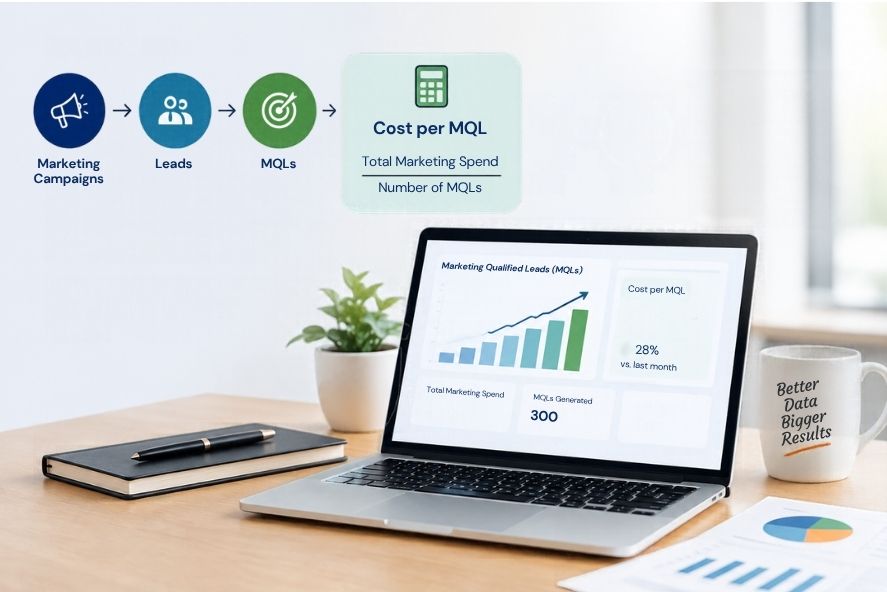
Cost per MQL, or cost per Marketing Qualified Lead, measures how much a business spends to generate one marketing qualified lead.
A simple formula is:
Cost Per MQL = Total Marketing Spend ÷ Number of MQLs Generated
For example, if a campaign spends ₹2,00,000 and generates 100 marketing qualified leads, the cost per MQL is ₹2,000.
The calculation is simple, but businesses need to define what qualifies as an MQL before measuring the metric.
Why is Cost Per MQL Important?
Not every lead has the same value. Some people may download a resource once and never engage again, while others may repeatedly visit a website, attend a webinar, request information, or demonstrate clear interest in a service.
Measuring cost per MQL helps businesses understand how efficiently marketing investment is generating leads that meet predefined qualification criteria.
It can also help teams compare campaigns, channels, audience segments, and offers.
How should businesses define an MQL?
Before calculating cost per MQL, marketing and sales teams should agree on what makes a lead marketing qualified.
An MQL could be based on factors such as:
- Engagement with multiple pieces of content
- Downloading a high-value resource
- Attending a webinar
- Visiting important service pages
- Completing a high-intent form
- Matching a defined target audience
- Showing repeated website engagement
The exact definition should depend on the company’s sales process and customer journey.
What marketing costs should be included?
Businesses need a consistent approach when calculating the metric.
Depending on the reporting model, marketing spend may include:
- Paid advertising
- Content creation
- Marketing software
- Campaign management
- Email marketing
- Webinar promotion
- Agency costs
- Landing page development
Not every organisation needs to include every cost in every calculation. The important point is to use the same methodology when comparing performance across campaigns or periods.
How can businesses calculate Cost Per MQL by channel?
Calculating the metric separately for each channel can provide more useful insights.
For example, a business could compare:
SEO: Total SEO-related investment ÷ MQLs generated from organic activity
Paid advertising: Advertising and campaign costs ÷ MQLs generated
Email marketing: Campaign costs ÷ MQLs generated
Webinars: Promotion and event-related marketing costs ÷ MQLs generated
This can show which channels are generating MQLs more efficiently.
However, businesses should avoid judging channels based only on cost. A channel with a higher cost per MQL may still generate better-quality leads or more sales opportunities.
Is a lower Cost Per MQL always better?
Not necessarily.
A low cost per MQL can look positive, but it may indicate that a campaign is generating a large number of low-quality leads.
For example, Campaign A may generate MQLs at ₹1,000 each, while Campaign B generates them at ₹2,000 each. If Campaign B produces significantly more sales opportunities and customers, it may deliver greater business value despite having a higher cost per MQL.
This is why businesses should compare cost with lead quality, opportunity creation, conversion rates, and revenue.
How can businesses reduce Cost Per MQL?
Businesses can improve efficiency by examining the complete lead generation process.
They can start by improving audience targeting so campaigns reach people who are more likely to fit their ideal customer profile. Landing pages should clearly explain the offer and make the next action simple.
Marketing teams can also test different content, messages, channels, and calls to action. Reviewing which campaigns generate qualified leads rather than just form submissions can help reduce inefficient spending.
Lead scoring and better marketing-to-sales alignment can further improve the quality of MQLs being passed to sales teams.
What other metrics should be tracked?
Cost per MQL should not be viewed in isolation.
Businesses can combine it with:
- MQL-to-SQL conversion rate
- Cost per sales qualified lead
- Lead-to-opportunity conversion
- Customer acquisition cost
- Lead quality
- Sales pipeline generated
- Customer conversion rate
- Marketing-sourced revenue
These metrics help connect marketing spending with actual business outcomes.
Final Thought
Cost per MQL gives businesses a practical way to understand how efficiently marketing investment generates qualified leads. However, the metric becomes more useful when combined with lead quality and downstream sales performance.
Instead of simply trying to reduce the cost of each MQL, businesses should focus on generating qualified prospects that can move through the sales process and contribute to sustainable revenue growth.
About The Author
