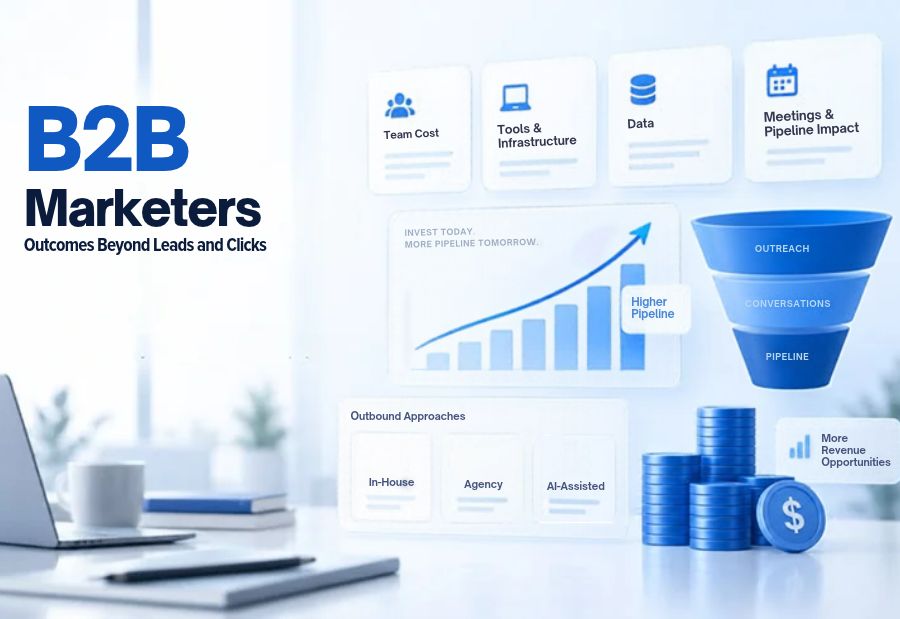
How can B2B Marketers Measure Business Outcomes Beyond Leads and Clicks?
Marketing teams often evaluate campaign performance through impressions, clicks, website visits and lead generation. Platforms such as Google Ads and LinkedIn Campaign Manager provide campaign data that helps marketers track audience engagement and advertising performance. Although these metrics help measure campaign activity, they do not always explain how marketing contributes to business growth. B2B marketing measurement needs to go beyond surface-level engagement and connect marketing activities with sales opportunities, revenue and customer acquisition. Mercadeo focuses on integrated B2B marketing activities where campaign performance can be evaluated against meaningful business objectives.
Why are Traditional Marketing Metrics Not Enough?
Clicks, impressions and form submissions are useful indicators of audience engagement. However, they do not necessarily represent genuine buying interest or revenue potential.
For example, a campaign may generate a large number of form submissions but only a small percentage may meet the company’s target customer profile. Another campaign may attract fewer leads but generate more qualified opportunities and contribute to higher-value deals.
This difference shows why businesses should not evaluate campaigns only by the number of leads generated. They also need to understand lead quality, sales progression and the commercial value created by marketing activities.
What are Outcome-Based Marketing Metrics?
Outcome-based marketing measurement evaluates marketing performance through its contribution to specific business objectives rather than focusing only on campaign activity.
These objectives may include:
- Generating qualified sales opportunities.
- Increasing sales pipeline value.
- Improving customer acquisition efficiency.
- Contributing to closed-won revenue.
- Increasing customer lifetime value.
- Improving conversion rates across the buyer journey.
The purpose is to understand whether marketing investments are producing meaningful commercial results.
6 Metrics That Connect Marketing Activities with Business Results
- Marketing-Qualified Leads and Sales-Qualified Leads
Marketing-qualified leads (MQLs) are prospects who meet defined marketing engagement or qualification criteria. Sales-qualified leads (SQLs) are prospects assessed as suitable for direct sales engagement.
Tracking the movement from MQL to SQL helps businesses evaluate whether campaigns are attracting relevant prospects and whether marketing and sales teams agree on lead quality.
- Sales Pipeline Contribution
Pipeline contribution measures the value of sales opportunities associated with marketing activities. Businesses can analyse how many opportunities marketing campaigns influence or generate and the potential value of those opportunities.
It is important to define whether a report measures marketing-sourced pipeline or marketing-influenced pipeline because these represent different forms of contribution.
- Customer Acquisition Cost (CAC)
Customer acquisition cost measures the average cost of acquiring a new customer.
A basic formula is:
CAC = Total Acquisition Costs ÷ Number of New Customers Acquired
Businesses can include relevant marketing and sales expenses in the calculation. Tracking CAC across channels helps identify which acquisition activities are more cost-efficient.
- Marketing Return on Investment (ROI)
Marketing ROI evaluates the financial return generated in relation to marketing investment.
A commonly used formula is:
Marketing ROI = (Revenue Attributed to Marketing − Marketing Investment) ÷ Marketing Investment × 100
Businesses should clearly define which revenue and costs are included. Revenue attribution can be complex in B2B environments because multiple campaigns and interactions may influence a single purchase.
- Lead-to-Customer Conversion Rate
This metric measures the percentage of leads that eventually become paying customers.
Lead-to-Customer Conversion Rate = (Number of New Customers ÷ Total Leads) × 100
Comparing this metric across channels helps marketers understand which sources are generating leads that are more likely to convert.
- Customer Lifetime Value (CLV)
Customer lifetime value estimates the total value a business expects to receive from a customer throughout the relationship.
When compared with customer acquisition cost, CLV helps businesses assess whether their acquisition strategy supports sustainable growth rather than focusing only on initial conversions.
How Can Businesses Build an Outcome-Based Measurement Framework?
A practical measurement framework should connect marketing objectives with sales and financial data.
Step 1: Define business objectives
Start by identifying the outcomes marketing needs to support, such as qualified pipeline growth, new customer acquisition or revenue contribution.
Step 2: Map metrics to the buyer journey
Connect campaign engagement with lead qualification, sales opportunities and customer conversions. Each stage should have relevant performance indicators.
Step 3: Integrate marketing and sales data
Connect advertising platforms, website analytics and CRM systems to understand how prospects move from initial engagement to sales opportunities and closed deals.
Step 4: Establish attribution rules
Define how marketing interactions receive credit for generating or influencing opportunities. Avoid treating every influenced deal as revenue generated solely by marketing.
Step 5: Review performance regularly
Compare campaign costs, lead quality, pipeline contribution and revenue outcomes. Use these insights to improve channel allocation and campaign strategy.
Common Challenges in Measuring Marketing Outcomes
Outcome-based measurement can be difficult when marketing and sales teams use separate reporting systems, customer data is incomplete or attribution rules are inconsistent. Long B2B sales cycles also make it challenging to connect early campaign interactions with eventual revenue.
Businesses should address these issues through consistent data definitions, CRM discipline, reliable tracking and regular coordination between marketing and sales teams.
Final Thought
Effective B2B marketing measurement should explain more than how many people clicked an advertisement or submitted an enquiry. It should show how marketing activities contribute to qualified opportunities, customer acquisition and business revenue.
By connecting campaign data with CRM and sales outcomes, businesses can make better investment decisions and identify the channels that support sustainable growth. Mercadeo helps organisations approach B2B marketing through integrated strategies that connect audience engagement, lead generation and measurable business objectives.
About The Author
