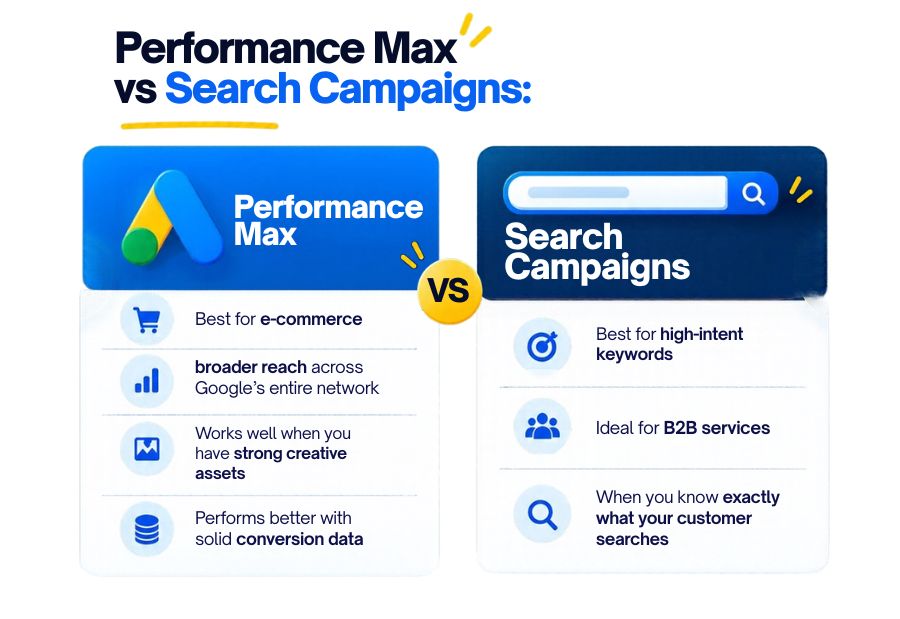
Performance Max vs. Search Campaigns: Which Google Ads Strategy Fits Your Goals?
Choosing the right campaign type is an important part of building an effective Google Ads strategy. While some businesses want to reach customers across multiple digital channels, others want to connect with people actively searching for specific products or services. Performance Max vs. Search campaigns is therefore an important comparison for marketers planning their advertising budgets.
Google Ads offers both campaign types to support different marketing objectives. Performance Max uses Google’s AI to optimise advertising across multiple Google channels, while Search campaigns focus on reaching users through relevant search queries. Understanding their differences can help businesses select the right approach for lead generation, sales and website traffic.
What are Performance Max Campaigns?
Performance Max is a goal-based campaign type that uses Google’s AI to help advertisers reach potential customers across Google’s advertising inventory.
Depending on campaign eligibility and settings, ads can appear across:
- Google Search
- YouTube
- Google Display Network
- Discover
- Gmail
- Google Maps
Advertisers provide creative assets such as headlines, descriptions, images and videos, along with audience signals, conversion goals and bidding preferences. Google’s systems use these inputs to identify opportunities and optimise campaign delivery.
Performance Max is useful for businesses that want to expand their reach across multiple channels while focusing on specific outcomes, such as online sales or lead generation.
What Are Search Campaigns?
Search campaigns help businesses display text ads when users search for products, services or information related to their offerings on Google.
These campaigns are built around keywords, search intent, ad groups and relevant landing pages. Advertisers can organise keywords according to specific services, product categories or customer requirements.
For example, a B2B marketing company may target searches such as:
- B2B lead generation services
- Account-based marketing services
- Demand generation agency
- B2B digital marketing solutions
Search campaigns are particularly useful for reaching people who are already looking for a solution and may be closer to making a purchase decision.
Performance Max vs. Search Campaigns: Key Differences
Although both campaign types can generate leads and sales, they differ in targeting, creative formats, placements and campaign management.
| Comparison Factor | Performance Max | Search Campaigns |
| Main approach | AI-driven, goal-based optimisation | Keyword and search-intent-based advertising |
| Ad placements | Multiple Google channels | Primarily Google Search and eligible Search Network inventory |
| Creative assets | Text, images and videos | Primarily text-based search ads and associated assets |
| Targeting | AI-driven audience and intent signals | Keywords, match types and audience settings |
| Reach | Broad, cross-channel reach | Users searching for relevant terms |
| Management | Greater automation | More direct control over keywords and ad groups |
| Best suited for | Expanding reach and optimising conversions across channels | Capturing specific search demand |
The right choice depends on campaign objectives, available creative assets, conversion tracking and the level of control required.
1. Targeting and Audience Reach
Performance Max uses Google’s AI to identify potential customers across different channels. Advertisers can provide audience signals to guide the campaign’s learning process, but these signals do not work in the same way as strict keyword targeting.
Search campaigns provide more direct control over keyword selection and match types. Advertisers can use exact, phrase and broad match keywords to connect ads with relevant search queries.
Which is better?
Performance Max can be useful when businesses want to discover additional audiences. Search campaigns are more suitable when advertisers want to focus on specific search intent and keyword themes.
2. Ad Formats and Creative Requirements
Performance Max supports multiple creative formats. Advertisers can provide text, images, logos and videos that Google’s systems combine to create ads for different placements.
Search campaigns primarily use responsive search ads, where Google combines multiple headlines and descriptions to create relevant ad variations.
Which is better?
Performance Max is suitable for businesses with a range of creative assets and a need for cross-channel visibility. Search campaigns are a practical choice when the main objective is to communicate a specific offer to users searching for it.
3. Budget and Bidding Strategy
Both campaign types support automated bidding strategies, including conversion-focused and value-based approaches, depending on the campaign setup and available goals.
Performance Max automatically allocates delivery across eligible inventory to pursue the selected campaign objectives. Search campaigns use bidding strategies to compete for relevant search opportunities.
Businesses should establish realistic budgets and ensure that conversion tracking is accurate before relying on automated optimisation.
Which is better?
Neither campaign type is automatically more cost-effective. Performance should be evaluated through cost per conversion, conversion value, lead quality and return on ad spend.
4. Control and Campaign Management
Search campaigns allow advertisers to organise keywords, ad groups, negative keywords and search targeting settings. This makes it easier to manage campaigns around specific products, services and search themes.
Performance Max automates more of the targeting and placement decisions. However, it also provides controls such as audience signals, search themes, brand exclusions and negative keywords, along with reporting options that help advertisers understand campaign activity.
Which is better?
Search campaigns offer more direct keyword-level management. Performance Max is suitable when businesses are comfortable using automation while providing clear goals, assets and campaign guidance.
5. Reporting and Performance Measurement
Both campaign types provide performance data, but marketers should review the available reports according to their campaign objectives.
For Search campaigns, useful indicators include:
- Search terms
- Click-through rate
- Conversion rate
- Cost per conversion
- Search Impression Share
For Performance Max, advertisers can review:
- Conversion and conversion value data
- Asset and asset group performance
- Channel performance
- Search term insights and placement information where available
Businesses should also connect advertising data with CRM and analytics platforms to understand whether generated leads progress into qualified opportunities.
When Should Businesses Choose Performance Max?
Performance Max may be a suitable option when:
- The objective is to generate leads or increase sales across multiple channels.
- The business has suitable text, image and video assets.
- Advertisers want to expand beyond existing keyword-based search traffic.
- Conversion tracking and campaign goals are clearly configured.
- The business wants to use Google’s automated optimisation capabilities.
It can be especially useful for businesses looking to increase reach while measuring performance against defined conversion goals.
When Should Businesses Choose Search Campaigns?
Search campaigns may be a better starting point when:
- Customers actively search for specific products or services.
- The business has clearly defined keyword groups.
- Advertisers need direct control over search targeting.
- Campaigns focus on high-intent searches.
- The business wants to test demand for specific services or offerings.
For B2B companies, Search campaigns can help capture enquiries from decision-makers who are already researching a solution.
Can Businesses Use Performance Max and Search Campaigns Together?
Yes. Businesses do not always need to choose one campaign type over the other. Performance Max can complement keyword-based Search campaigns by helping advertisers reach additional audiences and discover conversion opportunities across Google’s channels.
For example, a B2B marketing company could use Search campaigns to target specific service-related keywords while using Performance Max to expand reach and generate additional leads.
Advertisers should monitor campaign overlap, conversion quality, budget distribution and search-term performance. Google also applies campaign prioritisation rules; for example, eligible Search campaigns with exact match keywords can be prioritised over Performance Max for matching queries.
Mercadeo can help businesses align their paid marketing activities with lead generation goals, campaign measurement and sales pipeline requirements. A clear strategy should guide how each campaign type contributes to the overall marketing plan.
Final Thought
Performance Max and Search campaigns serve different purposes within Google Ads. Performance Max is designed to expand reach and optimise results across multiple Google channels, while Search campaigns help businesses connect with users actively searching for relevant products or services.
The right strategy depends on the audience, campaign objective, budget, creative resources and quality of conversion data. By evaluating these factors, businesses can decide whether to use one campaign type or combine both to support their advertising goals.
About The Author
