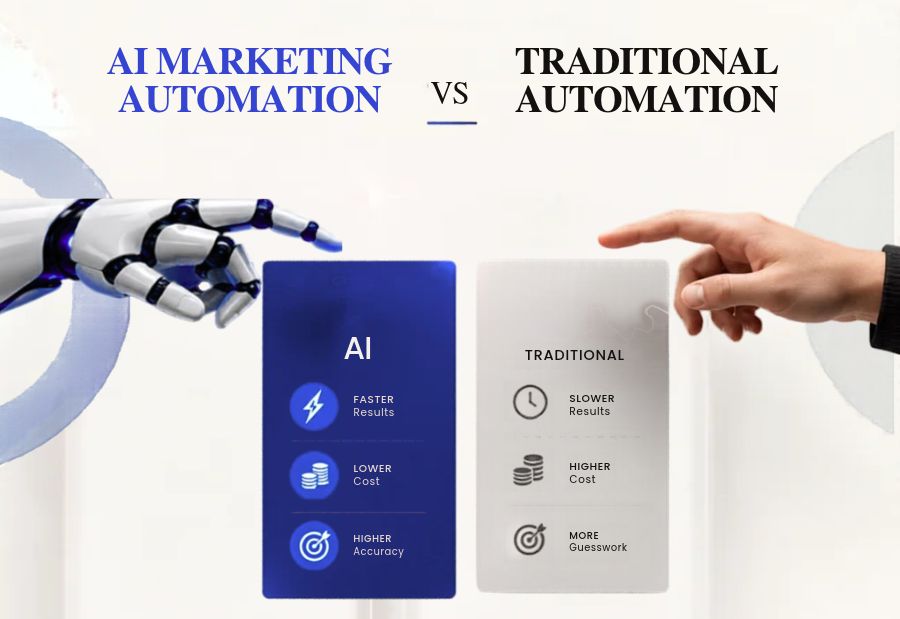
AI Marketing Automation vs. Traditional Automation: What Is the Difference?
Marketing automation helps businesses manage repetitive tasks, deliver timely communications, and coordinate campaigns across channels. Platforms such as HubSpot and Salesforce offer marketing automation solutions that help businesses manage customer interactions and improve campaign workflows. As artificial intelligence becomes more widely used, marketers have more options for analysing customer behaviour and adapting their activities. Understanding AI marketing automation vs. traditional automation helps businesses choose an approach that matches their goals, data, and resources. Mercadeo can use these differences to evaluate how automation supports lead generation and campaign management.
What is traditional marketing automation?
Traditional marketing automation follows predefined rules, triggers and workflows. Marketers configure the system to perform specific actions when a condition is met.
For example, a business may send a welcome email after someone subscribes to a newsletter. It might also send a follow-up message three days after a resource download or notify a sales representative when a prospect fills out a contact form.
Common uses include:
- Scheduling email campaigns
- Sending welcome and follow-up messages
- Assigning leads based on predefined rules
- Segmenting contacts using selected criteria
- Managing campaign workflows and notifications
Traditional automation is useful when processes are predictable and the desired action can be defined in advance.
What is AI marketing automation?
AI marketing automation uses artificial intelligence techniques to support tasks such as analysing customer data, predicting likely behaviour, generating content suggestions and adapting certain marketing activities.
Depending on the platform, AI features may help marketers identify promising leads, recommend relevant content, predict conversion likelihood, or personalise communications using available customer information.
Common applications include:
- Predictive lead scoring
- AI-assisted email and content creation
- Recommendations based on customer behaviour
- Audience analysis and segmentation suggestions
- Forecasting campaign performance
- Identifying patterns across marketing data
AI capabilities vary between tools. Some systems make recommendations for human review, while others can automatically adjust selected campaign activities within configured limits.
AI marketing automation vs. traditional automation: Key differences
1. How decisions are made
Traditional automation follows rules established by marketers. AI-supported automation can analyse data to identify patterns and generate predictions or recommendations.
For instance, a rule-based workflow may assign points when a prospect visits a pricing page. An AI-based system may assess several signals to estimate the prospect’s likelihood of converting.
2. Personalization
Traditional systems personalise messages using known fields, such as industry, location, job title, or previous actions.
AI tools may use a wider range of available signals to recommend content or tailor messages. However, personalisation still depends on data quality, consent and the system’s capabilities.
3. Workflow management
Traditional workflows usually require marketers to define the sequence of actions and conditions. AI can help identify opportunities to adjust timing, prioritise contacts, or recommend alternative actions.
Human oversight remains important, particularly when automated decisions affect customer communication or lead qualification.
4. Data requirements
Traditional automation can work with relatively straightforward rules and contact information. AI applications often benefit from larger volumes of reliable, relevant data.
Businesses should review data accuracy, access permissions, privacy requirements and integration quality before introducing AI-driven processes.
5. Implementation and monitoring
Traditional workflows can be easier to configure when the process is simple and well understood. AI-based features may require additional testing, monitoring and evaluation to confirm that their recommendations are useful.
Neither approach removes the need for ongoing campaign reviews.
Which approach should businesses choose?
The right option depends on the marketing objective, available data, team capabilities and budget.
Traditional automation may be suitable when:
- Campaigns follow a consistent sequence.
- Businesses need reliable rule-based follow-ups.
- Marketing processes are relatively simple.
- Teams want predictable workflows with clear conditions.
AI marketing automation may be useful when:
- Teams need to analyse complex customer behavior.
- Lead prioritization requires multiple data signals.
- Personalization needs to adapt to changing customer interests.
- Marketers want support with forecasting or content recommendations.
Businesses do not necessarily need to choose one approach exclusively. Many marketing platforms combine rule-based workflows with AI-powered recommendations.
How to introduce AI into existing marketing workflows
Start by identifying a specific problem, such as slow lead qualification, repetitive campaign analysis, or inconsistent content personalisation. Then assess whether an AI feature can address that problem more effectively than the existing process.
Run a controlled pilot and establish baseline measures before implementation. Depending on the use case, track qualified leads, conversion rate, time saved, campaign cost, or sales acceptance rate.
Review the results against the original objective. Also check for inaccurate recommendations, unexpected customer experiences and privacy concerns. Mercadeo can use this approach to evaluate automation improvements without introducing unnecessary complexity.
Final Thought
AI marketing automation and traditional automation serve related but different purposes. Traditional systems provide consistency through predefined rules, while AI features can support prediction, analysis and more adaptive marketing decisions.
For most businesses, the practical goal is not to replace every existing workflow. It is to identify where AI adds measurable value and combine it with dependable automation, accurate data and human oversight. This balanced approach helps marketing teams improve efficiency while keeping campaigns relevant to business objectives.
About The Author
