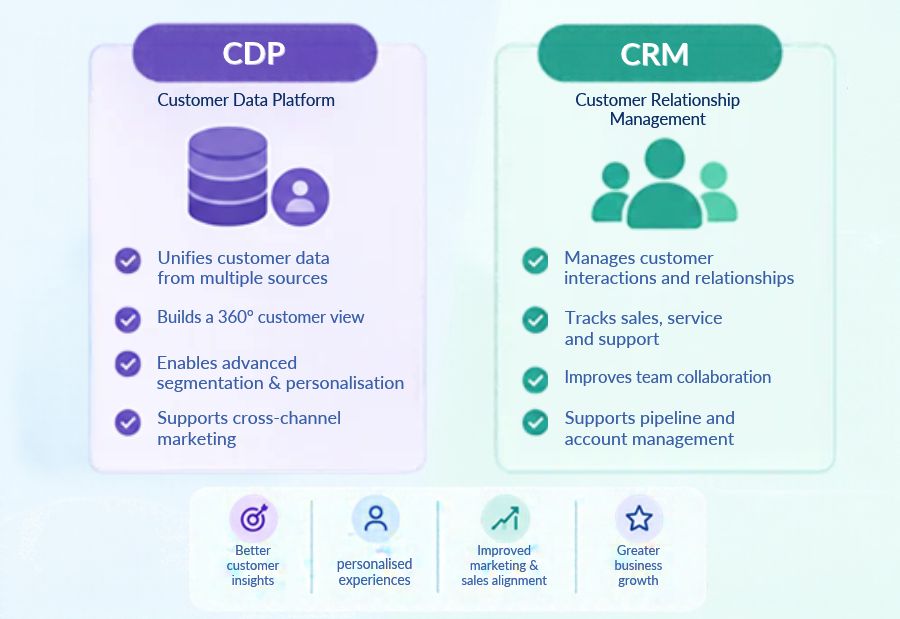
CDP vs. CRM: Key Differences, Benefits and Business Use Cases
Businesses collect customer information through websites, email campaigns, sales conversations, mobile applications and other channels. However, storing this information in separate systems can make it difficult to understand customer behaviour and deliver consistent experiences. Platforms such as Salesforce and Adobe offer solutions for customer relationship management and customer data management. Understanding CDP vs. CRM helps businesses decide how to organise customer information, support marketing and sales teams and improve customer engagement. At Mercadeo, a clear data strategy can help connect customer insights with more relevant marketing activities.
What is a customer data platform (CDP)?
A Customer Data Platform (CDP) collects and combines customer data from multiple sources to create unified customer profiles. Depending on its capabilities and configuration, a CDP can connect information from websites, mobile apps, email platforms, purchase records and other digital touchpoints.
For example, a customer may visit a product page, subscribe to a newsletter and later make a purchase. A CDP can bring together available information from these interactions to help marketing teams understand the customer journey and create more relevant audience segments.
CDPs are particularly useful for businesses that need to analyze behavior across channels, improve audience segmentation and support personalized marketing campaigns.
What is customer relationship management (CRM)?
Customer Relationship Management (CRM) software helps businesses manage interactions with prospects and existing customers. Sales and customer-facing teams use it to maintain contact details, track leads, record conversations, manage opportunities and monitor sales progress.
For example, a sales representative can use a CRM to record a prospect’s requirements, schedule a follow-up and track the opportunity through the sales pipeline.
CRMs are commonly used by sales, marketing and customer service teams to organise relationships and coordinate follow-up activities. Their exact features depend on the platform and plan.
CDP vs. CRM: 5 Key Differences
1. Primary Purpose
A CDP focuses on combining customer data from different sources to create unified profiles and support audience analysis. A CRM focuses on managing customer relationships, sales activities and direct interactions.
Although their functions can overlap, the main objective of each system is different.
2. Types of Data
A CDP may combine behavioral, transactional, demographic and campaign interaction data from connected sources. A CRM typically stores contact details, communication history, sales opportunities, account information and service records.
The information available in either system depends on the integrations, data quality and configuration.
3. Main Users
Marketing teams often use CDPs to build audience segments and understand customer behavior across channels. Sales representatives and account managers commonly use CRMs to manage leads, customer conversations and opportunities.
Other teams may also use these platforms depending on the organization’s needs.
4. Common Business Applications
CDPs can support audience segmentation, customer journey analysis and personalised campaign delivery. CRMs help businesses manage sales pipelines, plan follow-ups, maintain account records and coordinate customer communication.
A business may use both systems to connect customer insights with relationship management activities.
5. Data Integration
CDPs are designed to bring customer information together from multiple connected sources. CRMs can also integrate with marketing platforms, websites and other business applications, but their primary purpose remains managing customer relationships and interactions.
The level of integration depends on the products selected and how the systems are implemented.
CDP vs. CRM: Comparison at a Glance
| Feature | Customer Data Platform | Customer Relationship Management |
| Main purpose | Unify customer data | Manage customer relationships |
| Core focus | Customer profiles and behaviour | Contacts, interactions and sales opportunities |
| Common users | Marketing and data teams | Sales, service and account teams |
| Typical use cases | Audience segmentation and journey analysis | Lead management and sales tracking |
| Main value | A more connected view of customer data | Better organised customer interactions |
Benefits of using a CDP
A CDP can help businesses bring data from different channels into a more consistent view of the customer. This can support more relevant audience segments and help marketers understand how customers interact with their brand.
Other potential benefits include:
- Better audience segmentation: Group customers based on relevant behaviours and attributes.
- More relevant campaigns: Use available customer insights to tailor messages and offers.
- Improved customer journey analysis: Understand interactions across connected touchpoints.
- More consistent data: Reduce fragmentation when records can be matched and standardised appropriately.
These benefits depend on data quality, consent practices, integrations and the CDP’s capabilities.
Benefits of using a CRM
A CRM gives customer-facing teams a central place to manage relationships and sales activities. It can help businesses track prospects, record interactions and maintain visibility into the sales pipeline.
Key benefits include:
- Organised lead management: Keep prospect information and follow-up tasks accessible.
- Better sales coordination: Help teams track opportunities and responsibilities.
- Consistent communication: Maintain records of customer conversations and previous interactions.
- Pipeline visibility: Review deal stages and identify opportunities that need attention.
Can businesses use a CDP and CRM together?
Yes. A CDP and CRM can complement each other when their roles are clearly defined and the systems are properly integrated.
For example, a CDP may help a marketing team identify an audience that repeatedly engages with a product category. Relevant insights or qualified leads can then be passed to a CRM, where sales representatives can manage follow-ups and track opportunities.
In the other direction, suitable CRM information may help enrich customer profiles, subject to data availability, integration rules and privacy requirements.
Before connecting the platforms, businesses should define which data will be shared, how duplicate records will be handled and who is responsible for data quality, access and consent.
How to choose the right solution
Start with the business problem rather than the technology. If the priority is managing leads, sales conversations and customer accounts, a CRM may be the right starting point. If the challenge is connecting customer data across multiple channels for segmentation and analysis, a CDP may be more appropriate.
Businesses should also assess integration requirements, data governance, privacy obligations, implementation costs and the technical resources needed to maintain the system.
Final Thought
The choice between a CDP and a CRM depends on how a business collects, manages and uses customer information. A CDP helps connect customer data across sources, while a CRM supports organised customer interactions and sales activities. For some businesses, one platform may meet immediate needs; others may benefit from using both. Mercadeo can help businesses connect marketing objectives with customer insights and campaign planning to support more informed decisions and stronger customer engagement.
About The Author
