AI Lead Scoring vs. Rule-Based Lead Scoring: Which Method Is More Suitable?
Lead scoring helps B2B marketing and sales teams identify prospects who are more likely to become customers. However, businesses can assign lead scores in different ways. Platforms such as HubSpot and Salesforce offer lead management and scoring capabilities to help teams prioritize prospects. Some businesses use predefined rules, while others use artificial intelligence to analyse patterns in customer data. Understanding AI lead scoring vs. rule-based lead scoring helps businesses choose a method that fits their sales process, data availability, and marketing goals. At Mercadeo, lead scoring can support more focused lead generation and improve coordination between marketing and sales teams.
What is rule-based lead scoring?
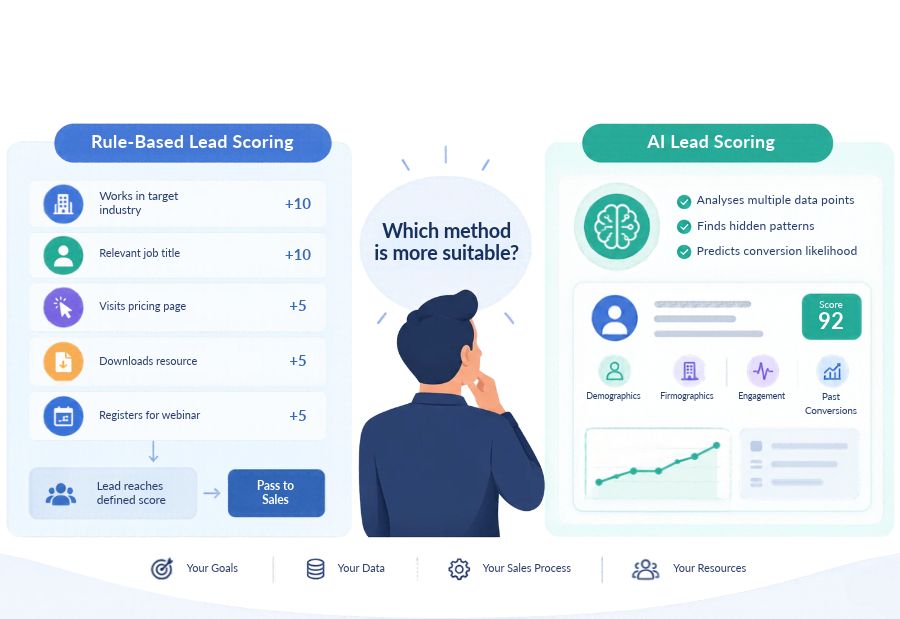
Rule-based lead scoring assigns points to leads according to conditions established by the marketing or sales team. These rules usually reflect a prospect’s profile, engagement, and actions.
For example, a B2B company might assign points when a prospect:
- Works in a target industry.
- Holds a relevant decision-making role.
- Visits the pricing page.
- Downloads a product guide.
- Registers for a webinar.
A prospect who reaches a predefined score may be passed to the sales team for follow-up.
Advantages of rule-based lead scoring
- Easy to understand and manage.
- Offers clear, consistent scoring criteria.
- Works well when sales processes are predictable.
- Requires less historical data than many AI-based approaches.
However, rules need regular updates. A scoring model may become less effective when customer behaviour changes or the original assumptions no longer reflect actual conversions.
What is AI lead scoring?
AI lead scoring uses machine learning or other AI techniques to analyse available data and estimate how likely a prospect is to take a desired action, such as becoming a qualified opportunity or customer.
Depending on the system, it may evaluate historical conversions, demographic information, firmographic details, website activity, campaign engagement, and previous sales outcomes.
Instead of relying only on manually assigned points, an AI model can identify patterns associated with successful conversions.
Advantages of AI lead scoring
- Can analyse multiple data points together.
- May identify patterns that are difficult to capture through manual rules.
- Can help prioritise leads based on predicted conversion likelihood.
- May adapt as new data becomes available, depending on the model and platform.
AI scoring also has limitations. Its usefulness depends on data quality, the number and relevance of past outcomes, model design, and ongoing monitoring. Poor data or biased historical patterns can lead to unreliable scores.
AI lead scoring vs. rule-based lead scoring: Key differences
1. Scoring method
Rule-based systems award points according to predefined conditions. AI systems use patterns in available data to generate predictions or scores.
For example, a rule-based model may assign points for downloading a white paper. An AI model may evaluate that action alongside industry, company size, other engagement signals, and historical conversion patterns.
2. Data requirements
Rule-based scoring can work with basic contact information and selected engagement activities. AI scoring often benefits from reliable historical data showing which leads progressed through the sales funnel and which did not.
Businesses with limited or inconsistent data may find it more practical to start with rules.
3. Flexibility and maintenance
Rule-based models are straightforward to review because teams can see the conditions behind each score. However, someone must update the rules when buying behavior or business priorities change.
AI models may identify changing patterns, but they still require monitoring, validation, and sometimes retraining. AI does not automatically guarantee that a scoring model will remain accurate.
4. Transparency
Rule-based scoring offers clear explanations for why a lead received a particular score. Some AI systems also provide explanations, but more complex models may be harder for teams to interpret.
Sales teams should understand what a score means and avoid treating it as a guaranteed prediction.
5. Cost and implementation
Rule-based scoring is often easier to implement with existing marketing automation or CRM tools. AI-based scoring may require additional integrations, data preparation, specialist support, or higher software costs.
The right comparison should consider total implementation and maintenance costs, not just the software subscription.
Which lead scoring method should businesses choose?
Rule-based scoring may be suitable when:
- The business has limited historical conversion data.
- The sales process follows clear qualification criteria.
- The team needs a transparent, easy-to-manage model.
- Lead volume and data complexity are relatively low.
AI lead scoring may be useful when:
- The business has sufficient reliable historical data.
- Sales teams handle a large number of leads.
- Multiple factors influence conversion outcomes.
- The organisation can monitor and validate model performance.
Some businesses can combine both approaches. For example, a team might use AI to estimate conversion likelihood while retaining mandatory qualification rules for geography, industry, budget, or compliance requirements.
How to evaluate lead scoring performance
Do not judge a lead scoring model only by how many leads receive high scores. Measure whether those leads progress through the sales funnel.
Useful metrics include:
- Lead-to-opportunity rate: The percentage of leads that become qualified opportunities.
- Sales acceptance rate: The proportion of marketing-qualified leads accepted by sales.
- Conversion rate: The percentage of leads that complete a defined conversion.
- Time to qualification: How long it takes to identify a sales-ready prospect.
- Revenue contribution: The pipeline or revenue associated with scored leads.
Compare results with a baseline and review performance across different audience segments. Mercadeo can use these measurements to identify whether a scoring approach improves lead prioritisation and supports better sales follow-up.
Final Thought
AI lead scoring and rule-based lead scoring both help businesses prioritise prospects, but they serve different needs. Rule-based scoring provides transparency and control, while AI scoring can identify complex patterns when suitable data is available.
The best approach depends on the organisation’s goals, data maturity, sales process, and resources. By testing the model and measuring actual sales outcomes, businesses can build a lead qualification process that supports more effective marketing and sales decisions.
About The Author
