How Can Businesses Create Effective Email Sequences for Cold B2B Outreach?
Reaching potential business customers through email takes more than sending a sales pitch. Businesses need relevant messaging, thoughtful follow-ups and a clear reason for prospects to respond. Platforms such as HubSpot and LinkedIn offer resources for B2B engagement, while Mercadeo helps businesses connect outreach campaigns with lead generation and sales goals. A well-planned cold B2B email sequence can help start meaningful conversations with potential buyers.
What is a cold B2B email sequence?
A cold B2B email sequence is a series of planned emails sent to relevant business prospects who have not previously engaged with the sender. The goal is to introduce an offering, demonstrate its relevance and encourage a useful next step.
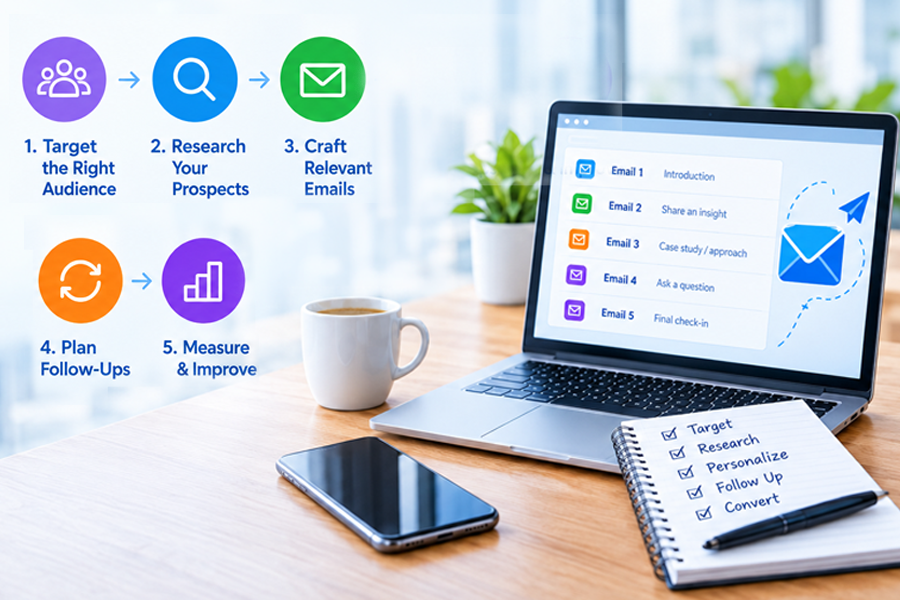
Instead of sending one email and waiting for a response, businesses use a sequence of messages that may include an introduction, a relevant business insight, a follow-up and a final check-in.
For example, a marketing services company may contact a B2B technology firm to discuss improving lead quality. Each email can focus on a different business challenge rather than repeating the same sales pitch.
How to create an effective cold B2B email sequence
1. Define the Right Target Audience
Start by identifying the businesses and decision-makers most likely to benefit from your offering. Consider factors such as industry, company size, business model, role and current business priorities.
For example, a campaign promoting account-based marketing services may target demand generation leaders, marketing heads, or revenue teams at B2B technology companies.
A clear ideal customer profile helps make the sequence more relevant and reduces time spent contacting unsuitable prospects.
2. Research Prospects Before Writing
Generic emails often fail because they do not address the recipient’s actual needs. Before writing, review publicly available company information, recent announcements, service offerings, or relevant industry developments.
Use this research to identify a genuine reason for reaching out. Avoid pretending to know a prospect personally or making unsupported claims about their business challenges.
Personalisation should explain why the message is relevant, not simply insert the recipient’s name or company name.
3. Write a Clear and Relevant First Email
The first email should introduce the sender, explain the reason for contacting the prospect and offer a useful next step.
Keep it short and focused on one business problem. Avoid long company introductions, excessive product details and multiple calls to action.
For example, a lead generation provider might explain how its services support B2B teams seeking to improve lead qualification. The message can then ask whether the prospect is open to a brief conversation.
The objective is to begin a relevant business discussion, not to close a deal in the first email.
4. Plan Follow-Ups With Different Messages
A good cold B2B email sequence adds value with each follow-up instead of repeating the same request.
A simple sequence could look like this:
- Email 1 — Day 1: Introduce yourself and explain the relevance of your offering.
- Email 2 — Day 4: Share a useful insight related to the prospect’s business challenge.
- Email 3 — Day 8: Explain a practical approach or relevant use case.
- Email 4 — Day 13: Ask a short question about the prospect’s priorities.
- Email 5 — Day 18: Send a polite closing message and leave the door open for future contact.
These timings are starting points, not fixed rules. Adjust the sequence according to your audience, sales cycle, engagement signals and applicable outreach requirements. Stop the sequence when someone replies, opts out, or otherwise indicates that further contact is unwanted.
5. Use One Clear Call to Action
Every email should make the next step easy to understand. Rather than asking for a meeting, a product demo, a referral and feedback in one message, focus on one request.
Examples include asking whether the topic is relevant, offering to share a useful resource, or suggesting a short introductory call.
A low-pressure, relevant question can make it easier for a prospect to respond.
6. Measure and Improve Email Performance
Track the metrics that help you understand whether the sequence is creating useful business conversations.
- Reply rate: Shows how many recipients respond.
- Positive reply rate: Measures responses that indicate genuine interest.
- Meeting booking rate: Tracks how often outreach leads to meetings.
- Qualified opportunity rate: Shows whether the conversations develop into relevant sales opportunities.
- Opt-out and complaint rates: Help identify targeting, relevance, or compliance problems.
Open rates can be misleading because email privacy features and automated systems may affect tracking. Use replies, qualified meetings and pipeline outcomes as stronger indicators of business impact.
Mercadeo can use these insights to refine audience targeting, messaging and campaign performance.
Common cold email mistakes to avoid
Avoid sending the same message to every prospect, using misleading subject lines, or writing lengthy emails focused only on your company. Do not rely on excessive follow-ups or unverified personalization.
Businesses should also follow applicable privacy and anti-spam requirements, use appropriate contact data, identify the sender accurately and provide a clear way to opt out where required. Email sequences should respect recipient preferences and suppression lists.
Final Thought
An effective cold B2B email sequence combines relevant targeting, concise messaging, useful follow-ups and measurable outcomes. The goal is not to send more emails; it is to start conversations with businesses that have a genuine reason to engage.
By testing messages, reviewing qualified responses and improving each stage of outreach, businesses can build a more consistent prospecting process. Mercadeo can help connect cold email outreach with broader B2B lead generation and sales objectives.
About The Author
